
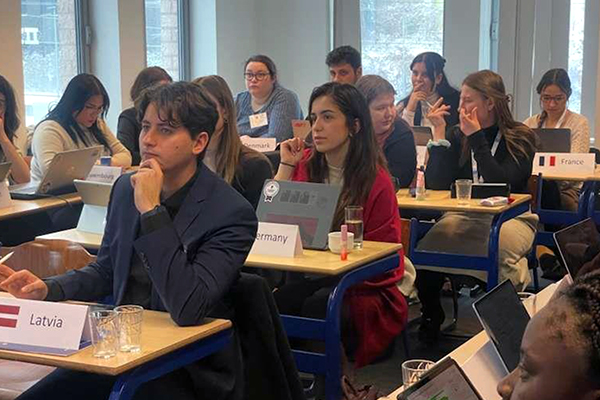
Seven students from SUNY Cortland participated in the Global Model European Union (GMEU) conference in Brussels, Belgium, in January, joining more than 120 students from 12 institutions across six countries. The students simulated the European Council and assumed roles as prime ministers, foreign ministers and defense ministers representing various EU member states. This immersive experience provided them with hands-on experience in international diplomacy and European politics.
The delegation included students representing Poland, Denmark and Portugal in various leadership capacities, according to the university. Participants enrolled in a fall course on the European Union to prepare for the simulation and better understand the complex dynamics between member states.
Understanding the Global Model European Union Experience
The Global Model European Union brought together students from the United States, Belgium, Bulgaria, France, Germany and the United Kingdom. SUNY Cortland was among five New York institutions participating, alongside Ithaca College, the University at Albany and the University at Buffalo. Students gathered at Vesalius College to engage in simulated negotiations on pressing international issues.
Emma Caraher, a triple major in history, anthropology and international studies, initially expressed skepticism about the workload involved. However, she later described the experience as ultimately rewarding, noting the opportunity to form new friendships and meet interesting people from diverse backgrounds.
Student Roles and Responsibilities
Layla Myers and Ava Graziano served as prime ministers of Poland and Denmark respectively, while Maria Fernandez and Caraher took on foreign minister roles for their assigned countries. Additionally, Maddie Houghton and Carly Hammond represented Poland and Portugal as defense ministers, and Zach Biemer served as the Portuguese representative on the Environmental Council.
Fernandez emphasized the value of applying academic research to practical diplomatic scenarios. She described interacting with peers who had dedicated substantial time to preparing for their roles as extremely enlightening and expressed gratitude for the opportunity.
Real-World Events Shape Model European Union Discussions
Participants addressed contemporary challenges including tariffs, the Middle East conflict, Ukraine, and cybersecurity during the conference. According to Professor of History Scott Moranda, who served as faculty advisor, real-time global events significantly influenced the simulation. The invasion of Venezuela and debates surrounding Greenland unfolded just before and during the conference, requiring student diplomats to respond authentically.
Moranda explained that the Global Model European Union offers students an invaluable opportunity to travel abroad, experience European cities and build international relationships. Meanwhile, participants gain direct knowledge about EU institutions and history that cannot be replicated in traditional classroom settings.
Building Practical Skills Through Simulation
The delegation also visited museums and enjoyed a day trip to Bruges, along with guest talks from EU dignitaries. Moranda credited support from the International Programs Office, the School of Arts and Sciences, the President’s Office and the Clark Center for Global Engagement for making the trip possible.
In contrast to online alternatives, Moranda emphasized that being physically present with students from multiple countries allows participants to learn compromise, craft proposals and find common ground in real time. Professor Alexandru Balas noted that Cortland was among the first U.S. universities to participate in Model EU conferences in 1988, originally called Model European Communities conferences.
Long-Term Benefits for Student Participants
Balas views the program as an effective method to build negotiating skills, test EU knowledge and gain confidence in public speaking. Biemer shared this sentiment, appreciating the networking opportunities while learning how countries with divergent goals reach consensus.
He reported gaining new leadership skills and reflected on the experience with no regrets, feeling he had embraced a new culture. The current GMEU format began in 2022, with Cortland making trips for the past three consecutive years.
SUNY Cortland plans to continue sending student delegations to future Global Model European Union conferences, though specific dates for the next event have not been announced. The university’s sustained participation reflects its commitment to providing international studies students with experiential learning opportunities in European diplomacy.
