
At two in the morning in late April, a certain kind of silence descends upon an open field. The air has that peculiar blend of winter’s remnants and spring’s arrival; it’s warm enough that you don’t immediately run inside, but it’s still cold enough that your breath is visible. The Lyrid meteor shower usually performs best in that precise window, which lies between unease and awe.
Every April, from the 16th to the 25th, the Lyrids arrive without much fanfare, peaking on the evening of April 21 and continuing into the early hours of April 22. These meteors burn up as they strike Earth’s atmosphere at incredible speed, briefly tracing white lines across the darkness. They are caused by debris shed long ago by Comet Thatcher, a comet that swings past the sun roughly every 415 years and won’t return until the 2280s. Observers can anticipate between 10 and 20 meteors per hour at peak in most years. In certain years, during what astronomers refer to as “outbursts,” that number has sharply increased, sometimes approaching 100 per hour. It’s genuinely unclear if 2026 will see one of those surges.
| Lyrid Meteor Shower — Key Information | Details |
|---|---|
| Event Name | Lyrid Meteor Shower |
| Active Period | April 16 – April 25, 2026 |
| Peak Date | April 22, 2026 |
| Origin Comet | Comet Thatcher (C/1861 G1 Thatcher) |
| Comet Orbital Period | 415.5 years |
| Zenithal Hourly Rate (ZHR) | 18 meteors per hour (typical); surges up to 100/hour possible |
| Best Viewing Time | After midnight, predawn hours of April 22 |
| Moon Interference | Minimal — moon sets after midnight |
| Equipment Needed | None — naked eye observation |
| Radiant Constellation | Lyra |
| Historical Record | Observed for over 2,700 years |
| Known For | Fast, bright meteors; occasional fireballs |
However, it is evident that this year’s viewing conditions are exceptionally favorable. This year, the moon sets after midnight, leaving several hours of properly dark sky at the height of the shower. In other years, the moon can completely wash out fainter meteors with its reflected light. It’s difficult to ignore how infrequently everything aligns so perfectly. The radiant point in Lyra rises well before dawn, the sky is dark, and the peak time is favorable. The year that skywatchers have been waiting for is finally here.
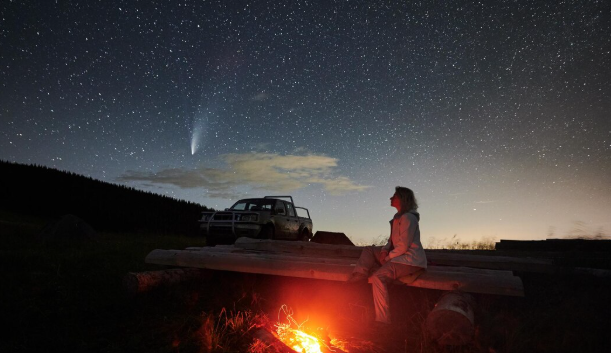
One of the reasons the Lyrids are accessible in a way that, say, a partial solar eclipse isn’t is that watching a meteor shower requires virtually no equipment. Not a telescope. Nothing more than a simple app to help you get around. NASA advises waiting at least half an hour outside before expecting to see anything in order to allow your eyes to fully acclimate to the darkness, something that most people don’t realize. That process is nearly completely reset by the urge to check your phone even once. Bring a blanket, lie flat on your back, and look eastward in general. Basically, that’s all there is to it. The difficult part is having patience.
Most people are unaware of how important location is. From a car window, a field twenty minutes outside a mid-sized city may appear deceptively dark, but there is still enough ambient light from far-off suburbs to significantly impair visibility. Genuine darkness, where the Milky Way is visible and your eyes feel as though they are adjusting to something real rather than merely a dimmed version of the same urban glow, is the aim. It works well in rural areas, on tree-free hilltops, or in designated dark sky parks. Because the radiant rises from that direction, coastal locations with distinct eastern horizons are especially ideal.
Knowing that people have been watching this same shower for more than 2,700 years has a subtle odd quality. It was noted by Chinese astronomers in 687 BC. No one alive will witness the return of the culpable comet, which hasn’t been seen since 1861. Every year in April, what falls across the skies is essentially old light, debris scattered centuries ago by something that burned up directly overhead and hasn’t been seen in over 160 years. The experience is not made more difficult by that context. If anything, it makes lying in a field at two in the morning seem less strange and more like taking part in something truly ancient.
The Eta Aquariids, which peak in early May, slightly overlap with the shower, which lasts until April 30. However, the window that everyone is focusing on is the evening of April 21 and the morning of April 22. Make an alarm. Look for a dark place. Although it’s still unclear if there will be an outburst this year, the circumstances are better than they’ve been in a long time, and that in and of itself seems worth staying up late.