
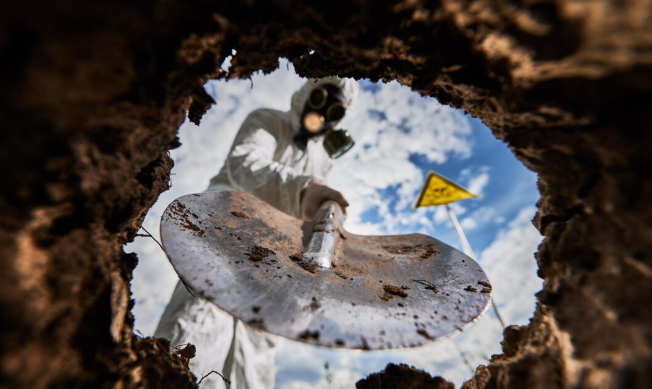
There is a rusted metal cap bolted into a concrete floor somewhere in the northern Russian Kola Peninsula, close to the Norwegian border, surrounded by Arctic forest and the kind of silence found only at the edge of the inhabited world. It’s not big. There is nothing dramatic about it. When tourists travel to the abandoned Soviet research station, they frequently express surprise at how unremarkable it appears—beyond the decaying wooden buildings, the strewn scrap metal, and the overall atmosphere of a project that ended badly and was never properly cleaned up.
The deepest hole ever drilled into the earth by humans is located beneath that nine-inch-diameter cap, which is fastened with a ring of thick bolts that have turned brown with age. It descends 12,262 meters. 40,230 feet is that. At the bottom of seven and a half miles of vertical darkness are a number of findings that still don’t neatly fit into the models that scientists were using at the time of the drilling.
| Subject | Kola Superdeep Borehole (SG-3) |
|---|---|
| Location | Pechengsky District, Kola Peninsula, Murmansk Oblast, Russia |
| Coordinates | 69.3965°N, 30.6100°E |
| Depth Achieved | 12,262 metres (40,230 ft / 7.6 miles) — deepest human-made hole on Earth |
| Diameter | 23 centimetres (9 inches) |
| Drilling Period | 1970–1994 (active drilling); project closed 1995 |
| Original Target Depth | 15,000 metres (49,000 ft) |
| Why Drilling Stopped | Temperatures reached 180°C (356°F) — far exceeding expected 100°C |
| Key Discoveries | No basalt layer found; liquid water at 3–6 km depth; microscopic fossils at 6 km; hydrogen-rich drilling mud |
| Current Status | Abandoned; sealed with bolted metal cap; site partially destroyed |
| Comparable Depths | Deeper than Mariana Trench (11,034 m); taller than Everest + Fuji combined |
| Penetration of Earth’s Crust | Approximately one-third; 0.2% of distance to Earth’s center |
| Reference | Wikipedia — Kola Superdeep Borehole |
Launched in 1970, the Kola Superdeep Borehole was a Soviet scientific endeavor motivated in part by real scientific aspirations and in part by the same Cold War competitive spirit that propelled Russians and Americans into space. The Soviet Academy of Sciences was covertly drilling into the Baltic Shield of the Kola Peninsula while NASA oversaw moon landings. They used a modified oil-well rig known as the Uralmash-4E and later a specially designed device named after the target depth, the Uralmash-15000, which was built to reach fifteen kilometers.
For almost twenty years, the project produced results, breaking the world depth record in 1979 and continuing steadily downward through the 1980s. It attracted the kind of sustained institutional commitment that large scientific endeavors required in the Soviet system. The project required a certain level of patience from the drilling crew, scientists, and support personnel working at the remote location: every meter took longer than the last, the rock became harder and hotter with each advance, and the engineering issues increased as the hole got deeper.
As the drill bit passed through rock that had never been touched by a human instrument, they discovered something they had not anticipated. At a depth of about seven kilometers, the first surprise occurred. At that depth, the Earth’s continental crust is thought to change from granite to denser basaltic rock, a boundary known as the Conrad discontinuity that can be seen in seismic wave readings and is generally regarded as established geology.
No such transition was discovered by the drill. Below seven kilometers, granite was present. Older, denser, and more granite, but still granite. It appears that something completely different—possibly a metamorphic change in the granite itself rather than a transition to a different rock—was responsible for the seismic readings that had indicated a rock-type boundary. Geologists’ understanding of the continental crust’s structure had to be drastically revised as a result of that discovery alone. It’s still not entirely resolved.
Even stranger was the water. The borehole came into contact with water at a depth of three to six kilometers, where the surrounding rock’s density and pressure were thought to make liquid water practically impossible. Not even a trickle. actual pooled water that had risen through granite fissures until it reached an impermeable layer that prevented it from rising further. When the Soviets initially reported this discovery, most Western scientists were skeptical.
At the time, it was widely believed that water could not pass through the crust at all because it was too dense at those depths. Contrary to what the Kola data claimed, later studies have shown that deep crustal water exists and is more prevalent than previously believed. With ramifications for everything from earthquake dynamics to mineral formation, that represents a substantial shift in our understanding of fluid movement within the planet.
The scientists working on the site described the drilling mud that circulated through the borehole and returned to the surface as boiling with hydrogen gas. This was unexpected, unexplained at the time, and still unclear in terms of what it revealed about the geochemical conditions at those depths.
At six kilometers below the surface, the drill found rock that contained microscopic fossils of single-celled marine organisms, essentially plankton, dating back about two billion years. This discovery may have been the most quietly astounding of all. Questions concerning the depth at which life once existed on Earth and possibly the depth at which microbial life might still exist in some form were raised by the discovery of biological material preserved in ancient rock that was found far below the surface. The answers to those questions are still incomplete.
The project ended in the grim manner that Soviet-era scientific initiatives frequently did: underfunded, overtaken by political developments, and finally halted by a physical issue that no one had sufficiently anticipated. Because temperatures had risen to 180 degrees Celsius in 1992—nearly twice what the geological models had predicted at that depth—drilling on the fourth hole was stopped at just under twelve kilometers. The apparatus was not made to function in those circumstances.
Drilling was practically impossible with the available tools because the rock at that depth had also changed its behavior due to the intense heat and pressure, becoming more flowing and plastic rather than rigid. The scientists had arrived at a wall that was not geological but rather thermal, and they were unable to get past it. Drilling ceased. In the chaos of post-Soviet Russia, funding vanished. The scientific team disbanded by 2007, the site was abandoned by 1995, and the site management company was liquidated by 2008.
When you think about what the Kola borehole represents, it’s difficult not to feel something. After twenty years of incredible work, the hole is nine inches across and not nearly as deep as originally intended. It is now sealed with bolts that tourists take pictures of because the contrast between the goal and the result is almost heartbreaking. However, the science that emerged from that hole was truly significant.
These discoveries—the hydrogen-rich mud, the unexpected water, the missing basalt layer, and the ancient fossils far below where they should have been—changed everything. They showed that the Earth, even the familiar crust on which we build everything, contains conditions and materials that don’t behave as the textbooks suggested, and that the models scientists use to understand what lies beneath the surface are less reliable than anyone had acknowledged. How much more is waiting down there is still unknown. The hole has been sealed. The queries it raised are not.