
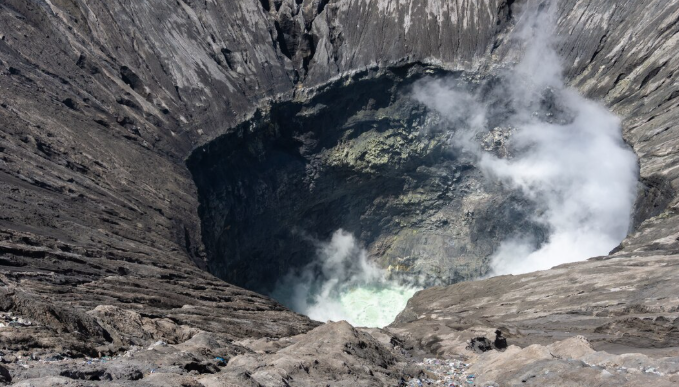
The ground has been rising for decades in the port town of Pozzuoli, just west of Naples. Not drastically, not in a way that would cause people to flee into the streets on any given Tuesday, but consistently, quantifiably, and with an accumulation that is now hard to ignore. The town has been raised about four meters since the 1950s by the agitated caldera beneath it.
Campi Flegrei, a 13-kilometer-wide volcanic depression that most visitors to the region have never heard of, is Europe’s closest approximation to a supervolcano, and it has been rising three to four centimeters per year in recent times, accompanied by earthquake swarms that rattled residents badly enough in May 2024 to send many of them camping in parks and car parks rather than sleeping indoors. That month, the biggest earthquake in forty years had a magnitude of 4.4. Over 1,200 smaller seismic events occurred in the weeks prior to it. Above this, 360,000 people reside. Before continuing, give that number some quiet thought.
Global Volcanic Activity — Key Facts & Context
| Field | Details |
|---|---|
| Is Activity Increasing? | The Smithsonian’s Global Volcanism Program finds no scientific evidence that volcanic activity is actually increasing — apparent rises in reported eruptions reflect better monitoring, satellite coverage, and population growth near volcanoes |
| Current Active Volcanoes | Approximately 30 volcanoes are actively erupting at any given point in time; around 1,350 are considered potentially active globally |
| Most Watched Volcano (Europe) | Campi Flegrei, near Naples, Italy — a 13km-wide caldera sitting beneath the port town of Pozzuoli; home to 360,000 residents; classified as Europe’s closest supervolcano equivalent |
| Campi Flegrei Ground Uplift | The caldera floor has risen by an extraordinary 4 meters (13 feet) since the 1950s; currently rising 3–4cm per year with periodic earthquake swarms |
| Recent Seismic Event | May 2024: magnitude 4.4 earthquake struck the Campi Flegrei area — largest in 40 years; part of a sequence of more than 1,200 seismic events over preceding weeks; residents evacuated homes |
| Campi Flegrei Largest Past Eruption | 36,000 years ago — Europe’s greatest volcanic blast in at least 200,000 years; deposited ash across the Mediterranean; triggered temperatures drops of up to 9°C across eastern Europe |
| Why Reports Seem to Spike | Historical record shows “peaks” in reported eruptions coincide with increased human attention — post-Krakatau (1883), post-Mont Pelée (1902), and post-WW II; “valleys” align with World Wars and the Great Depression when reporting collapsed |
| Large Eruption Frequency | Frequency of large eruptions (VEI ≥ 4, generating ≥0.1 km³ of tephra) has remained impressively constant for more than a century — the most reliable indicator of true global volcanic activity |
| Monitoring Milestones | Smithsonian cataloging began 1968; NASA’s Terra satellite (MODIS sensors) launched December 1999 — dramatically improved detection of eruptions in remote and sparsely populated regions |
| Media vs. Reality Effect | The 1980 Mount St. Helens eruption received enormous global coverage; the nearly identical 1956 Bezymianny eruption in Kamchatka (no fatalities) was barely reported — location and human impact drive news, not eruption size |
| Known Historically Active Volcanoes | Around 2,000 years ago only 10 volcanoes were on record; by 1400 CE the list had grown to 63; today more than 1,350 are catalogued — growth reflects exploration and record-keeping, not new volcanic formation |
| Key Monitoring Bodies | Smithsonian Institution Global Volcanism Program; USGS Volcano Hazards Program; Volcanic Ash Advisory Centers (VAACs); national observatories in Italy, Iceland, Japan, Indonesia, and the US |
The question that tends to surface whenever stories like this gather momentum — on social media, in YouTube thumbnails, in the kind of anxious late-night searches that follow a particularly alarming news cycle — is whether something is genuinely different now. Whether volcanoes around the world are becoming more active simultaneously, building toward something, responding to some planetary signal that scientists are privately worried about but reluctant to say out loud. It’s an interesting question. Additionally, it is largely based on a misperception of how volcanic data is gathered, reported, and interpreted over time.
The Smithsonian Institution’s Global Volcanism Program has been cataloguing eruptions since 1968, and its position on the apparent surge in global volcanic activity is unambiguous: there is no scientific evidence that volcanic activity is actually increasing. Our capacity to identify it has grown steadily and dramatically. NASA’s Terra satellite, equipped with MODIS infrared sensors, has been finding eruptions in remote and sparsely populated regions since December 1999 — eruptions that would have gone entirely unrecorded in previous centuries. The apparent increase in reported activity becomes much less mysterious when you consider the expansion of volcano observatories, the installation of seismic networks, the global reach of social media, and the fact that more people now live close to volcanoes than at any other time in human history.
It’s important to comprehend this historical pattern. The Smithsonian’s data, gathered from almost two centuries of records, reveals that reported eruptions drastically decreased during both World Wars—not because volcanoes became quieter, but rather because people were distracted and publications had different priorities. After the 1929 stock market crash, almost every volcanic region on Earth experienced a sharp decline in recorded activity, with the exception of Russia, Melanesia, and the West Indies.
This was the most dramatic drop in recorded volcanism. The eruptions from the volcanoes continued. Humans ceased to record it. The inverse is equally revealing: in the years following major, highly publicized eruptions like Krakatau in 1883 or Mont Pelée in 1902, reported volcanic activity surged — not because of any actual geological pulse, but because public attention focused and reporters filed stories they might otherwise have ignored.
Volcanologists are more concerned with the behavior of individual systems that are exhibiting signs of change following extended periods of relative quiet than with the total number of active volcanoes, which has remained relatively stable. Campi Flegrei is the most discussed in Europe, and for understandable reasons — the combination of its population density, its proximity to Naples, and the consistent ground deformation it has been showing makes it the kind of situation where scientists choose their words very carefully in public. According to one researcher, the key question is how much further the crust can stretch before collapsing. No one can provide a precise response to that. The story lies in that uncertainty.
Media coverage of Mount St. Helens’ 1980 eruption was extensive both domestically and internationally. The remarkably similar eruption of Bezymianny in Kamchatka in 1956 — comparable in scale, but located in a sparsely populated corner of the Soviet Union with no Western press presence — barely registered in the international record. There were two eruptions. Only one contributed to the public’s awareness of the threat posed by volcanoes. The majority of people’s perceptions of volcanic risk have been influenced by this discrepancy between what actually happens and what is reported, in ways that are still not entirely understood decades later.
The public discourse and the scientific discourse seem to be moving in slightly different directions, based on the coverage of Campi Flegrei that has accumulated over the past year. A significant eruption is not predicted by scientists. They claim that the ground is rising, the system is operational, and they are keeping as close an eye on it as technology permits. That’s a significant statement. Additionally, it differs from an alarm. The distinction is important, even though it may seem academic to the 360,000 residents of Pozzuoli who experienced more than 1,200 earthquakes in a few weeks.
