
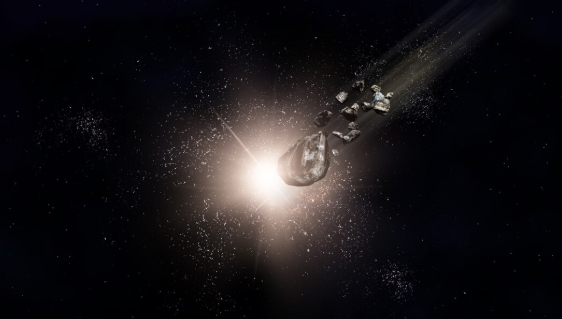
A collection of Hubble photos sat quietly for years, seemingly unremarkable, in the digital vaults of NASA’s Mikulski Archive, a repository containing decades’ worth of telescope data from over a dozen space missions. While perusing that archive, UCLA planetary scientist David Jewitt discovered observations of 41P/Tuttle-Giacobini-Kresák, a tiny comet shaped like a potato. It turns out that what he discovered in those pictures was unprecedented in the annals of astronomy. The comet’s rotation had not simply slowed. It had completely turned it around.
Comet 41P is not the type of object that typically attracts notice. It is incredibly small to be speeding through the solar system on a 5.4-year orbit around the Sun; it is about 0.6 miles across and three times the height of the Eiffel Tower. Before Jupiter’s gravity rerouted it into its present course, it most likely started in the Kuiper Belt, that frozen ring of debris beyond Neptune. For more than a century, scientists have been aware of it. It has traveled through the inner solar system numerous times without doing anything noteworthy. Then 2017 arrived.
| Category | Details |
|---|---|
| Comet Name | 41P/Tuttle-Giacobini-Kresák (41P) |
| Size of Nucleus | ~0.6 miles (approx. 1 km) across — roughly 3x the height of the Eiffel Tower |
| Origin | Kuiper Belt; redirected by Jupiter’s gravity |
| Orbital Period | Every 5.4 years around the Sun |
| Time in Current Orbit | Approximately 1,500 years |
| Key Event | First-ever observed comet spin reversal (documented 2017, published March 2026) |
| Rotation Before Reversal | ~8–10 hours (March 2017, Lowell Observatory) |
| Rotation at Slowest Point | 46–60 hours (May 2017, NASA Swift Observatory) |
| Rotation After Reversal | ~14 hours in opposite direction (December 2017, Hubble) |
| Lead Researcher | David Jewitt, University of California, Los Angeles |
| Telescopes Involved | Lowell Discovery Telescope, NASA Swift Observatory, NASA Hubble Space Telescope |
| Published In | The Astronomical Journal (March 2026) |
| Reference Website | NASA Science — Hubble Detects First-Ever Spin Reversal |
Astronomer Dave Schleicher and his colleagues at Arizona’s Lowell Observatory used the 4.3-meter Discovery Channel Telescope to track comet 41P as it got closer to the Sun in March of that year. They recorded the data—baseline observations, which are typically filed and cited but seldom serve as the basis for a significant discovery—and measured the rotation period.
Two months later, scientists examined the same comet with NASA’s Neil Gehrels Swift Observatory and discovered a problem. Compared to March, it was spinning three times more slowly. A comet had drastically slowed its own rotation over the course of roughly sixty days. The numbers weren’t subtle, but no one had a clear explanation yet.
Then, in December, Hubble took a look. 41P was spinning quickly once more, averaging about 14 hours per rotation, rather than slowing down. Here’s the problem, though. It was spinning in the other direction. After analyzing the data, the researchers came to the most straightforward conclusion: 41P’s rotation slowed until it almost completely stopped, at which point gas jets on its surface—venting frozen material heated by the Sun—pushed it into reverse, similar to someone reaching out and spinning a slowing merry-go-round in the opposite direction.
That analogy was nearly exactly what Jewitt used. “If it’s turning in one direction, and then you push against that, you can slow it and reverse it.” It’s a surprisingly straightforward picture for something that seems to have never occurred in any comet that has ever been seen.
It’s difficult to ignore that for a little while. For thousands of years, astronomers have been observing comets. They were the subject of whole mythologies created by ancient societies. Records of Halley’s Comet date back at least to 240 BC.
However, this specific behavior—a comet reversing its own rotation—had never been observed before. Both proximity and luck play a role in that. Qicheng Zhang of Lowell Observatory noted that the majority of small comets likely undergo comparable changes but either pass too far from Earth to observe them clearly or disintegrate before anyone can take a second measurement. Due to an orbital geometry coincidence, 41P passed near enough to observe.
The way the discovery actually occurred—through a scientist looking through an archive on what one imagines to be an otherwise ordinary afternoon, rather than through some planned observing campaign or urgent real-time alert—is what gives the story an almost novelistic feel. The December 2017 Hubble data had been sitting there for years without being examined. Anyone can access the archive. Jewitt discovered it, identified what it was displaying, and in late March 2026, the discovery was published in The Astronomical Journal. There may be dozens of similar findings waiting in that same archive, connected to observations that no one has had a chance to examine yet.
People are still being surprised by the comet itself. Its surface is burning through volatile ices more quickly than anticipated, possibly leaving behind insulating dust layers that are gradually choking off its output, as evidenced by the fact that its activity level in 2017 was about ten times lower than what researchers measured during its passage in 2001.
The nucleus may eventually spin itself apart due to centrifugal force overpowering the weak gravity holding it together, according to models of its rotation rate and mass loss. “I expect this nucleus will very quickly self-destruct,” Jewitt stated. That has an almost melancholic quality. A comet that has been circling the Sun for about 1,500 years may not make many more orbits.
It is genuinely unclear if 41P actually fragments on its subsequent pass or the one that follows. Comets don’t work well together. They change in ways that are hard to accurately model, and “quickly” in the context of astronomy can still refer to centuries. But the trajectory, if the models hold, is toward structural failure rather than long-term survival.
Seeing this develop, or more accurately, seeing scientists piece it together from old telescope logs and archived images, serves as a reminder of how much is still changing in a solar system that most of us silently believe to be stable. It isn’t. Not even near.