
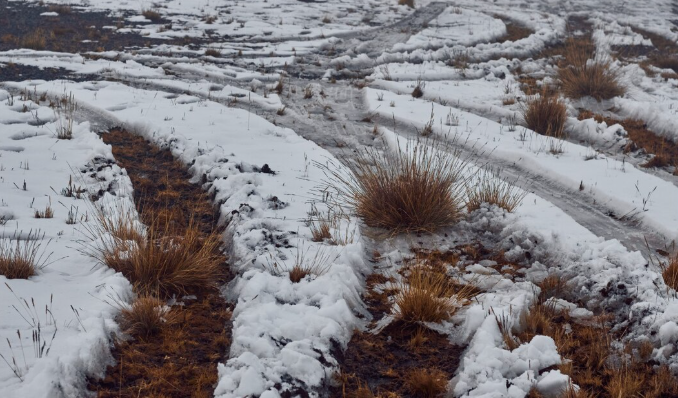
Like many scientific narratives, it started in an unimportant location. A patch of ground. It’s the kind of ground you would pass by without noticing—it’s cold and a little damp. Researchers discovered something that doesn’t behave like water should somewhere in that typical environment. Or perhaps it’s more accurate to say that water has always been more bizarre than we realized.
Water does not freeze as quickly as school textbooks claim when it is left unattended. Even at seemingly impossible temperatures, it can stay liquid. However, everything changes when the correct particle—a tiny scaffold—is added. Ice quickly forms and spreads outward, transforming invisible vapor into a heavy, structured substance. This fungus can help with that.
| Category | Details |
|---|---|
| Discovery | Ice-nucleating soil fungus |
| Key Ability | Freezes water at temperatures as high as -2°C |
| Mechanism | Produces cell-free proteins that trigger ice formation |
| Scientific Process | Ice nucleation |
| Potential Use | Cloud seeding, weather modification, climate modeling |
| Traditional Alternative | Silver iodide (toxic chemical) |
| Research Institutions | Virginia Tech, Boise State University |
| Reference | EurekAlert Research Release |
A soil fungus that can produce proteins that cause ice to form at temperatures as low as minus two degrees Celsius was recently discovered by scientists. On paper, that detail seems almost insignificant, but when you sit with it, it feels important. This suggests that the atmosphere, which is full of water vapor and tiny particles, may be far more susceptible to biological activity than previously thought.
Water droplets, some liquid and some frozen, are placed side by side on a surface in a laboratory setting even though their temperatures are the same. The cold isn’t what makes a difference. It’s a fungal protein that silently arranges water molecules into the inflexible ice pattern. There is a sense that the line separating biology and weather is more hazy than it appears when observing that contrast.
The process, known as ice nucleation, is not wholly novel. For many years, scientists have been aware that some bacteria have similar abilities. However, it turns out that fungi have improved the procedure. They release stable, free-floating proteins that carry out the task more neatly and effectively rather than depending on entire cells. It’s possible that evolution came up with a solution that engineers are just now starting to comprehend while working slowly underground.
The implication of weather control is another issue that continues to garner attention.
Cloud seeding, which frequently uses chemicals like silver iodide to promote rain, has been around for a long time. The concept is straightforward: add particles to clouds, provide water with a surface to freeze on, and let gravity take care of the rest. However, there are environmental issues with those approaches, and there is disagreement about their efficacy. In contrast, the fungal protein has an almost unsettlingly natural feel. Of course, it’s still intervention. However, the soil itself is the source of this intervention.
Researchers are cautiously optimistic. If these proteins can be produced in large quantities, they may provide a safer way to affect precipitation, which could help areas that are vulnerable to drought, control snowfall, and possibly even stabilize specific climate patterns. Here, though, optimism is accompanied by hesitation. The potential unintended consequences of releasing biological ice-makers into the atmosphere are still unknown.
Small changes in climate science frequently have a cascading effect. For example, clouds play a complicated role in controlling temperature by reflecting sunlight, retaining heat, and changing patterns across continents. More than just rainfall could be altered by changing how ice forms inside of them. It might gently alter the atmosphere’s energy balance.
Additionally, the discovery has an almost philosophical quality. Giant mirrors in space, chemical injections into the stratosphere, and daring interventions that seem top-down have all been used to portray geoengineering as a high-tech project for many years. This fungus offers an alternative strategy. amplifying existing systems rather than creating new ones.
The contrast is difficult to ignore. Billion-dollar climate technologies, on the one hand. Conversely, a microscopic organism has spent millions of years silently honing its skills. There’s a sense that nature may have been practicing its own form of climate engineering long before humans had the idea to try.
The atmosphere is not where the story ends. These proteins may also have an impact on how we store sensitive medical supplies, freeze food, and preserve biological tissues. Protecting cellular structures, preventing damage, and freezing at higher temperatures all seem sensible, almost routine. However, it originates from the same mechanism that could eventually affect rainfall.
Uncertainty persists, though. There are no easy answers to questions like understanding ecological impact, ensuring safety, or scaling production. Additionally, a more general worry that frequently looms over geoengineering is how the technology will be applied once it is developed.
This finding subtly challenges the narrative surrounding climate solutions. It implies that machines or large infrastructure may not always be the source of the tools we’re looking for. Occasionally, they arise from neglected areas of the natural world, offering prospects that are both encouraging and a little unsettling.
Because there has always been some weight associated with controlling the weather, even in an indirect way. And that possibility appears a little closer now.