
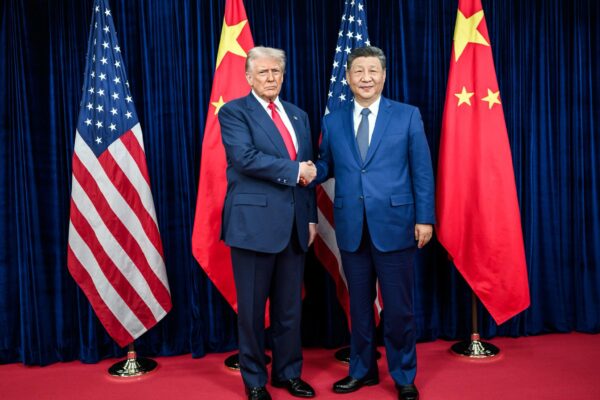
President Donald Trump is scheduled to visit China from March 31 to April 2, marking his second trip to the country and his first since returning to office. According to The Diplomat, preparations for the Trump-Xi summit continue despite recent tensions surrounding U.S. military operations and ongoing trade disputes between the world’s two largest economies.
The upcoming visit follows Trump’s previous China trip in November 2017, when he received unprecedented treatment including a tea reception at the Forbidden City hosted by Chinese President Xi Jinping. The White House described that earlier visit as establishing a foundation for productive engagement between the nations.
However, bilateral relations deteriorated sharply after the Trump administration initiated a trade war in July 2018 by imposing 25 percent tariffs on Chinese imports. These tensions continued throughout Trump’s first term and persisted during the Biden administration, fundamentally altering the U.S-China relationship.
Tariff Disputes Dominate U.S-China Relations
The relationship appeared promising after Trump’s November 2024 election victory, with the president-elect frequently highlighting his rapport with Xi. China sent Vice President Han Zheng to Trump’s inauguration, representing the highest level of Chinese participation at any U.S. presidential swearing-in ceremony.
Nevertheless, Trump imposed sweeping Liberation Day tariffs on April 2, 2025, targeting virtually all U.S. trading partners with China receiving the highest rates. China responded with retaliatory measures, leading to accumulated U.S. tariffs on Chinese imports reaching 145 percent while China imposed 125 percent tariffs on American goods.
Additionally, Beijing implemented export restrictions on rare earths and paused U.S. soybean imports, directly impacting American farmers who form a significant portion of Trump’s political base. After multiple negotiation rounds, both countries agreed to a tariff truce that temporarily stabilized economic relations.
Strategic Issues Complicate Summit Preparations
When Trump met with Xi in Busan, South Korea on October 30, he called China the “biggest partner of the U.S.” and claimed the countries maintained “a fantastic relationship,” according to China’s Foreign Ministry. During that meeting, Trump confirmed his spring 2026 China visit plans.
Meanwhile, speculation has emerged regarding potential concessions Trump might offer China. The Trump administration recently withheld a $13 billion weapons sale to Taiwan, according to The New York Times, though analysts suggest this represents a tactical delay rather than abandonment of the island’s defense.
In contrast to his first term, Trump’s current National Security Strategy and National Defense Strategy avoid labeling China as America’s “pacing threat.” Secretary of State Marco Rubio has demonstrated pragmatism by advocating for engagement and dialogue with China, departing from his previous hardline senatorial stance.
Expected Deliverables from the Trump-Xi Summit
Experts suggest the upcoming China visit should focus on achievable outcomes rather than resolving fundamental conflicts. Extending the current tariff truce represents a primary objective, allowing both nations to address trade-related problems without imposing additional duties.
The U.S. goods trade deficit with China declined to $202 billion in 2025, according to The New York Times, representing the lowest level in over two decades. This development indicates China’s willingness to increase purchases of American products including oil and Boeing aircraft under favorable political conditions.
Another potential agreement involves simultaneously reopening consulates in Houston and Chengdu. The United States closed China’s Houston consulate in July 2020, giving diplomats 72 hours to vacate according to Reuters, prompting China to shutter the U.S. Chengdu consulate in retaliation.
Promoting Educational and Tourism Exchanges
Enhancing tourism and people-to-people exchanges could buffer against political tensions between the nations. China has granted 30-day visa-free travel to citizens of numerous countries including Canada and the United Kingdom following recent leadership visits, according to the BBC.
Washington could encourage more Americans to travel to and study in China while Beijing might extend similar visa-free policies to U.S. citizens. Such initiatives would foster goodwill and understanding between American and Chinese populations beyond governmental relations.
Both leaders are expected to set aside contentious issues like Taiwan and the global order during the summit, focusing instead on strengthening trade relationships and societal exchanges. The success of Trump’s China visit will likely be measured by concrete agreements that stabilize bilateral relations rather than resolving long-standing strategic disagreements.
