
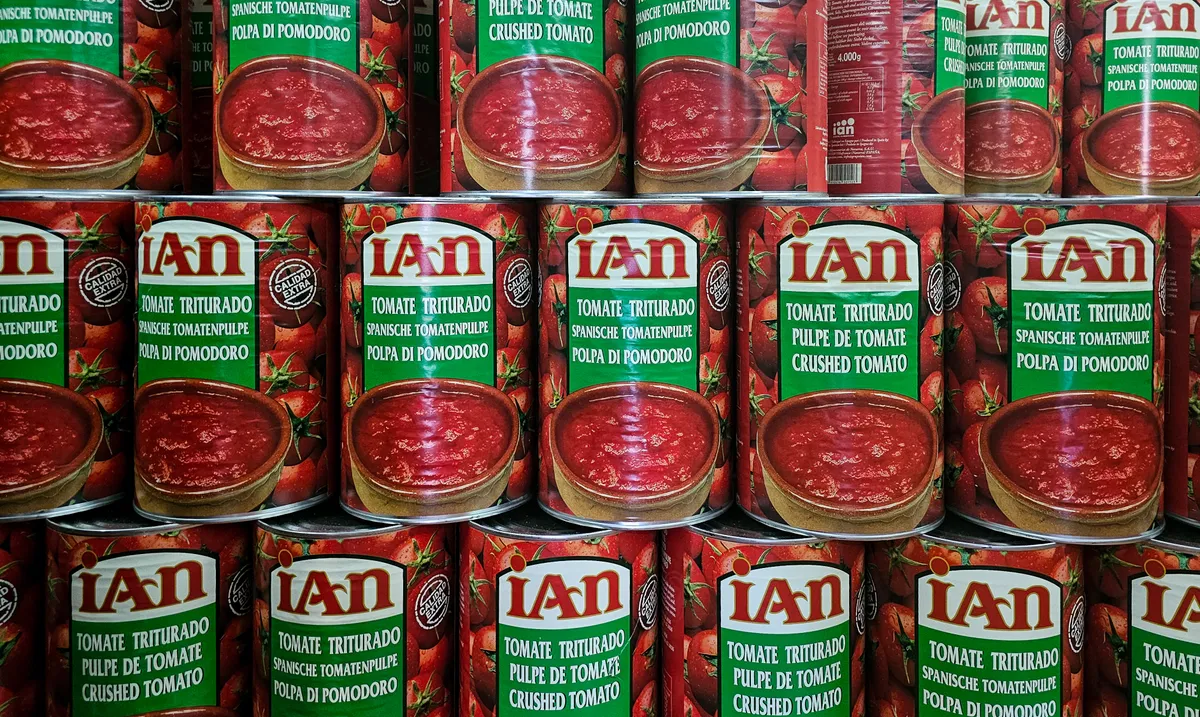
The tomato price spike hitting food stocks comes as retail prices reached $2.69 per pound in April, up nearly 40% year over year and the highest BLS-recorded level since 1980, putting Campbell’s and Conagra Brands in an uncomfortable position: both companies were already losing ground before input costs surged.
| Metric | Detail |
|---|---|
| Tomato price, April 2026 | $2.69/lb, +40% YoY (BLS) |
| Tomato price, March 2026 | $2.26/lb, +15% MoM |
| Fresh produce inflation, April 2026 | 6.5% YoY vs. 3.2% overall food |
| CPB consensus rating | Reduce, PT $22.88 |
| CAG consensus rating | Reduce, PT $15.27 |
| Mexico tariff on fresh tomatoes | 17% (initiated July 2025) |
The price run-up was not sudden. CNBC reported that field-grown tomatoes averaged $2.26 per pound in March, already the highest in more than eight years, after a 15% single-month jump. February had added another 6%. By April, the acceleration was clearly not a blip.
Three factors are driving it. Florida’s cold, wet 2026 growing season cut domestic supply. Elevated diesel costs, tied to the Iran conflict, raised trucking expenses at exactly the wrong time for a perishable crop that cannot be moved to storage. And the 17% tariff on Mexican tomatoes, imposed in July 2025, is now flowing fully through spring 2026 prices since the prior growing season had already cleared inventory before the tariff landed.
Domestic producers cover only about 30% of supply. Mexico accounts for roughly 90% of imports. The tariff is not a background risk; it is a structural cost embedded in every case of fresh tomatoes moving through the supply chain this season.
Fresh produce is running well ahead of the broader food basket. Blue Book Services put fresh fruit and vegetable inflation at 6.5% year over year in April, more than double the 3.2% overall food inflation rate. That gap matters for companies whose margins depend on predictable commodity costs and whose pricing power with consumers is already being tested.
Campbell’s Tomato Price Spike Exposure Comes on Top of Multi-Quarter Weakness
Campbell’s (NASDAQ: CPB) brands with direct tomato exposure include Prego, Rao’s, V8, and Campbell’s Soup. The problem is that the tomato price spike for food stocks like CPB lands on a company already deteriorating across multiple quarters. Barchart data on Campbell’s Q1 FY2026 (reported December 9, 2025) showed net sales down 3% to $2.7 billion, adjusted EBIT down 11% to $383 million, and adjusted EPS down 13% to $0.77. Shares fell 5.2% that day.
Q2 was worse on guidance. The company slashed its fiscal 2026 EPS outlook by 26%, with snack margins down 7%. Then, in early June, Campbell’s updated full-year FY2026 adjusted EPS guidance to $2.15 to $2.25, bracketing the Street consensus of $2.17. The same week, Bernstein downgraded CPB from Market Perform to Underperform and cut its price target from $21.00 to $19.00, below current levels.
The Rao’s acquisition is a specific drag. Consumers have pushed back on $9 pasta sauce jars in an environment where trading down is visible across the grocery store. Premium brands face a harder sell when household budgets are stretched by broad food inflation.
CPB is down roughly 20% over three months and carries a Reduce consensus with an average analyst price target of $22.88. The stock is trading near $21, so the target offers little upside buffer, and Bernstein’s $19 call suggests the risk is still skewed lower.
Conagra’s Numbers Show the Tomato Price Spike Compressing Gross Profit Directly
Conagra (NYSE: CAG) runs Hunt’s, RAGU, Chef Boyardee, and Healthy Choice, making its tomato exposure as direct as any company in the packaged food sector. The Q3 FY2026 press release shows net sales fell 1.9% to $2.8 billion, gross profit dropped 7.4% to $658 million, and adjusted EPS came in at $0.39, down 23.5% from $0.51 in the prior year period.
The company is projecting 7% COGS inflation for the full fiscal year. Free cash flow was cut nearly in half year over year. CAG’s dividend yield sits near 11%, which typically signals a payout the market does not believe is sustainable at current earnings levels.
Both stocks carry Reduce ratings. CAG trades around $12.86, well below its 52-week high of $22.81, with a consensus target of $15.27. The tomato price spike hitting food stocks adds a new cost layer to two companies that were already cutting guidance and watching margins compress before spring planting season even showed up in spot prices.
For CAG, the next binary event is whether the company trims its dividend. A cut would likely accelerate selling. For CPB, the Bernstein $19 target becomes the key level to watch if the broader tape softens into summer.