
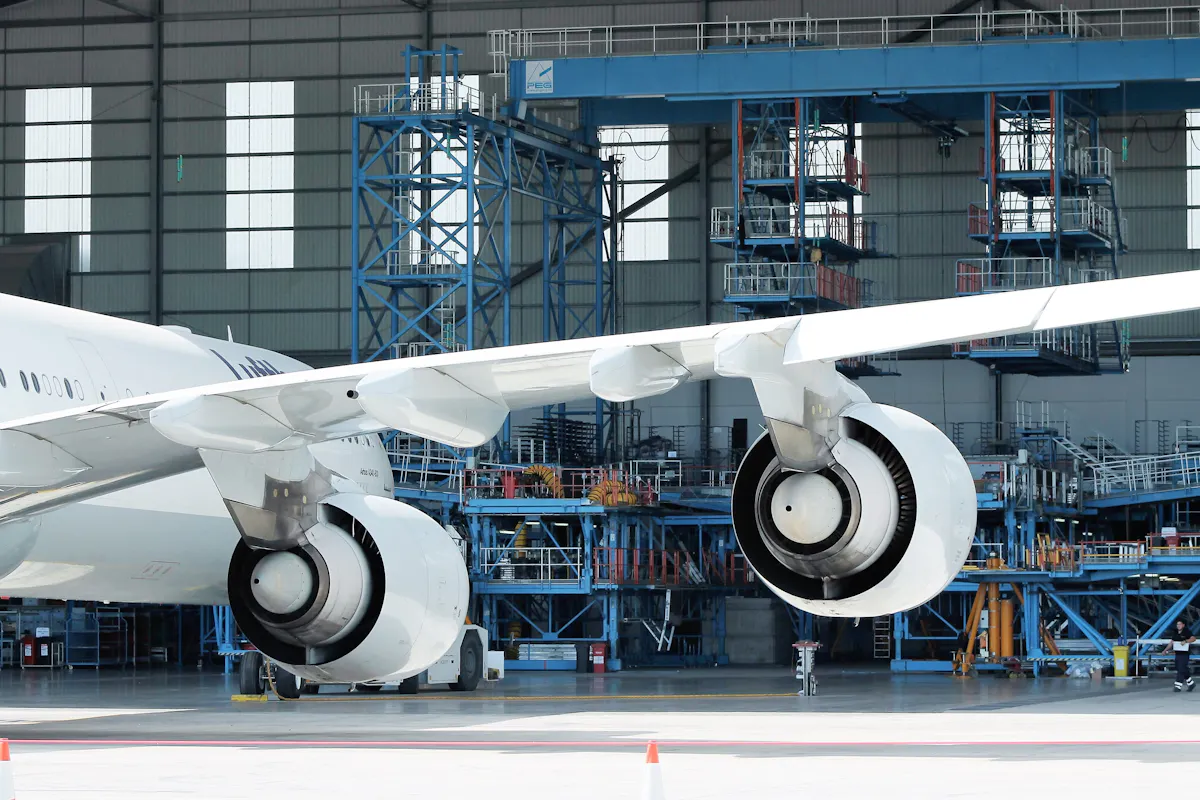
The 737 MAX production rate at Boeing (NYSE: BA) cleared 47 jets per month this week, following FAA sign-off and a landmark 200-aircraft order from Chinese airlines, two catalysts that are reshaping the bull case for the stock.
| Metric | Value |
|---|---|
| Current 737 MAX rate (authorized) | 47/month |
| Next rate target | 52/month (early 2027) |
| China order size | 200 aircraft |
| Q1 2026 revenue (YoY) | $22.2B, +14% |
| Q1 2026 operating cash flow deficit | $179M (vs. $1.62B a year ago) |
| Consensus price target | $259.80 (Moderate Buy, 23 analysts) |
FAA Clears Higher 737 MAX Production Rate After Years of Caps
CEO Kelly Ortberg confirmed the move at the Bernstein Annual Strategic Decisions Conference in New York on May 27, saying Boeing had “passed a capstone review for rate 47” and is “off and rolling.” FAA Administrator Bryan Bedford backed the ramp personally, a notable public endorsement from the regulator that imposed the original cap.
That original cap was set at 38 jets per month after the January 2024 midair panel blowout on an Alaska Airlines 737 MAX 9. The FAA lifted the formal numerical restriction in March 2026, switching instead to a performance-based oversight model tied to Boeing’s Product Quality Management System. Under that framework, Boeing moved from 38 to 42 in late 2025, and now to 47.
Ortberg also stated a longer-term ambition of 63 jets per month. The more immediate milestone is 52, which requires activating a fourth 737 line at the Everett, Washington facility, targeted for early 2027.
China Order Reopens a Market That Was Gone for Nearly a Decade
The 200-aircraft commitment from Chinese airlines, announced following President Trump’s summit with Chinese President Xi Jinping, is the first major Boeing sale to China in nearly a decade. The last comparable deal was a 300-aircraft order in 2017. Before trade disputes and the MAX grounding overlapped, Chinese customers absorbed roughly a quarter of Boeing’s annual 737 deliveries, according to AP News.
Ortberg was part of the U.S. business delegation in Beijing. Boeing’s management has described the 200-plane deal as an initial tranche, suggesting follow-on orders are part of the structure.
The strategic value here goes beyond the headline unit count. A reopened Chinese market provides the demand absorption needed to run the Everett expansion without building surplus inventory. Without it, accelerating the 737 MAX production rate into 2027 carried real margin risk. Now that risk is substantially lower.
Cash Flow Numbers Support the Turnaround Thesis
The Q1 2026 financials give the production and order story a concrete financial footing. Revenue came in at $22.2 billion, up 14% year-over-year, across all segments, per the Q1 2026 earnings summary. The operating cash flow deficit narrowed to $179 million from $1.62 billion in the year-ago quarter, a $1.44 billion sequential improvement.
Boeing’s Q1 10-Q filing shows a backlog of $694.7 billion as of March 31, with 24% expected to convert to revenue by 2027. Net loss attributable to shareholders was $4 million, or $0.11 per diluted share. GAAP operating margin reached 2.0% for the quarter. The company still carries $47.2 billion in consolidated debt against $20.9 billion in cash and marketable securities.
Full-year 2026 free cash flow guidance is $1 to $3 billion, with heavier second-half weighting. Analyst consensus projects FCF expanding to $6.4 billion in 2027 and crossing $10 billion by 2028, contingent on the 737 MAX production rate continuing to climb.
Key Risks Tied to Supply Chain, Not Regulators
The risk profile has shifted. Two years ago, existential regulatory threats dominated. Now the primary constraint is supply chain: engine availability from vendors including GE Aerospace (NYSE: GE) and the broader aerospace component network, which remains stretched across the industry.
Boeing’s Q1 press release also flags the integration of Spirit AeroSystems, the fuselage supplier Boeing acquired, as a forward-looking risk factor. Bringing that supply in-house could improve quality control over the long run, but near-term integration costs and operational friction are real variables heading into 2027.
The 737-7 and 737-10 variants are expected to receive FAA certification in 2026, with first deliveries anticipated in 2027. Those certifications add incremental demand optionality to an already full backlog.
At $228.97, BA trades at a wide discount to the $259.80 consensus target, based on 23 analyst ratings at Moderate Buy. The next clean read on whether the 47-rate cadence is holding without quality slippage will come with Q2 2026 delivery data, likely in early July.